Table of Contents
Managing customer calls efficiently is crucial for success in today’s fast-paced business environment. Companies must decide between two popular solutions: the virtual receptionist vs automated answering service. This decision significantly impacts customer satisfaction, operational costs, and overall business efficiency.
Virtual receptionists offer a human touch, providing real-time interaction for complex queries and sensitive issues. They bring empathy and adaptability to conversations, often building stronger customer relationships. On the other hand, automated answering services powered by AI excel in handling high volumes of routine inquiries with speed and consistency, operating 24/7 without fatigue.
As businesses aim to balance personalization with scalability, understanding the strengths and limitations of each option becomes crucial. Keep reading to explore the differences between virtual receptionists and automated answering services, and determine which service fits your business needs and goals.
What is an Automated Answering Service?
An automated answering service operates through pre-programmed systems that manage phone interactions without human involvement. These services use interactive voice response (IVR) technology to guide callers through menu options, collect basic information, and route inquiries. They handle repetitive tasks like appointment confirmations, payment processing, and reminders through recorded messages and touch-tone inputs.
What is a virtual receptionist service?
A virtual receptionist service employs remote professionals to handle calls and administrative tasks in real-time. These agents provide personalized interactions, such as appointment scheduling, call transfers, and customer support, all while representing your business as an extension of its team. Unlike automated systems, they adapt to nuanced requests and build rapport through empathetic communication.

Virtual Receptionist vs Automated Answering Service: What’s the Difference?
When it comes to deciding between a virtual receptionist vs automated answering service, businesses must consider several factors, such as operational needs and customer service priorities. Virtual receptionists offer human-led interactions that can handle complex, multi-step issues, while automated answering services excel at providing instant, consistent responses to basic, routine inquiries.
Here’s a comparison table of key features to help you decide which option works best for your business:
| Feature | Virtual Receptionist | Automated Answering Service |
|---|---|---|
| Interaction Type | Human-led conversations | Pre-recorded or AI-generated responses |
| Availability | Limited to service hours (often extended shifts) | 24/7 operation |
| Cost Efficiency | Higher per-call costs | Lower operational expenses |
| Query Complexity | Resolves multi-step issues | Handles routine inquiries only |
| Customer Perception | 83% prefer human agents for critical interactions | 65% efficiency rate for basic tasks |
Businesses must balance immediate cost savings with long-term customer loyalty. Hybrid models that combine AI to screen calls and route complex issues to virtual receptionists are increasingly popular for optimizing service efficiency.
How Do Virtual Receptionist vs Automated Answering Service Work?
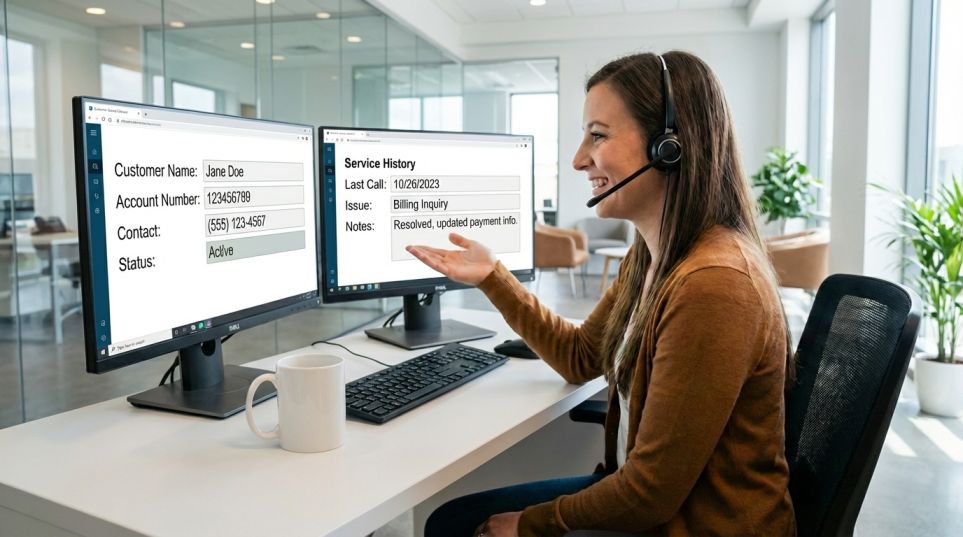
Virtual receptionist services use remote professionals who are trained in client-specific scripts. Calls are routed to these agents who answer in real-time, mimicking an in-house team member. These agents screen calls, schedule appointments, and relay messages using cloud-based telephony, integrating with your business’s CRM and calendar systems for seamless data management.
On the other hand, automated answering services operate through IVR technology. When a call arrives, the system triggers a pre-recorded greeting and offers menu options via voice prompts or touch-tone inputs. Callers select options like “Press 1 for billing” or make speaking requests, which the system processes using speech recognition. Routine tasks, such as appointment confirmations or payment reminders, are handled autonomously. More complex cases trigger call transfers to human agents or departments.
What Are the Benefits of Automated Answering Services and Virtual Receptionists?
Automated Answering Service Benefits:

- Cost-effectiveness: Reduces operational expenses by 60-90% compared to human teams.
- 24/7 Availability: Handles up to 80% of routine inquiries instantly, even during holidays or after-hours.
- Scalability: Can manage thousands of simultaneous calls without latency during peak times.
- Consistency: Ensures uniform responses to FAQs, maintaining brand messaging accuracy.
- Data Collection: Logs caller information for analytics and process improvements.
Virtual Receptionist Benefits:

- Human Empathy: Resolves sensitive issues, like billing disputes or complaints, with emotional intelligence, preferred by 83% of customers.
- Flexibility: Adapts scripts for industry-specific needs, such as legal intake forms or medical appointment reminders.
- Brand Representation: Trained agents mirror your company’s tone, enhancing professionalism and customer trust.
- CRM Integration: Updates client records in real-time and schedules follow-ups to boost retention.
- Hybrid Efficiency: Combines AI systems for initial call screening, reducing the workload for human agents by 40%.
Frequently Asked Questions About Virtual Receptionists vs Automated Answering Services
Can a virtual receptionist handle multiple calls at once?
Yes, virtual receptionist services like Ruby Receptionist use cloud-based telephony to manage calls without delays or dropped connections, ensuring no calls go unanswered, even during high-demand periods.
Is a virtual receptionist better than hiring an in-house receptionist?
Virtual receptionists offer significant cost savings (up to 90% less than in-house hires) and provide round-the-clock coverage without HR complexities, offering flexibility that traditional receptionists cannot.
Do virtual receptionists integrate with CRM or booking systems?
Yes, virtual receptionist services integrate with CRM platforms and scheduling tools through APIs, enabling seamless updates to customer records and automated appointment syncing.
Can an AI answering service handle complex customer inquiries?
No, AI answering services are designed for simple, routine tasks. Around 35-43% of complex queries require escalation to human agents.
Is an AI answering service more affordable than a human receptionist?
AI services cost 60-90% less than human receptionists. However, combining AI for basic tasks and virtual receptionists for more complex issues optimizes the cost-quality balance.
Conclusion: Choosing the Best Service for Your Business
When deciding between a virtual receptionist vs automated answering service, businesses need to consider their specific needs. If cost is the primary concern, an automated answering service may offer a more affordable solution for routine tasks. However, for businesses that prioritize customer satisfaction, empathy, and personalization, a virtual receptionist provides invaluable human interaction. Hybrid models that integrate both technologies are increasingly popular, offering the best of both worlds.
To learn more about virtual receptionist services, visit Ruby Receptionist.